I Will Ride.org
I Will Ride Blog
Speak Up
Act Now

New UCLA study finds Gold Line and Orange Line produce less smog and fewer greenhouse gases in both near- and far-term – The Source

Posted by GoldLine

The following article originally appeared on the The Source blog on May 20, 2013.

One of the arguments frequently made for building more mass transit — in particular rail projects — is that it will help reduce pollution and, as a byproduct, greenhouse gases that are contributing to climate change. The above chart comes from a Federal Transit Administration report updated in 2010 that considers the impacts of cars versus transit. Although in some circles this remains a disputed issue (mostly by critics of rail transit), the FTA finds transit is the clear winner.

Comparing the emissions of cars versus transit is not always a clear-cut issue because of the number of variables involved. Which brings us to a new study by several UCLA researchers that drills down deeper on the subject by comparing the Orange Line, Gold Line and average automobile in Southern California. The study was published in Environmental Research Letters and is posted below.

The study found that in both the near term and long-term, the Orange Line and the Gold Line produced less smog and greenhouse gases than the average auto driven in L.A. County. In addition, the Orange Line and Gold Line used less overall energy than cars and will create less particulate matter than cars in the long-term, although the Gold Line currently produces about the same as cars, due mostly to its electricity coming from coal-fired power plants used by the Los Angeles Department of Water and Power.

Four key points from the new study:

•Both cars and transit are expected to get cleaner over time as fuel mileage increases for cars and transit relies on cleaner energy sources, i.e. solar, wind, thermal and natural gas.

•Construction remains a big challenge for transit projects because things such as pouring concrete and the use of heavy equipment tends to result in high emissions of greenhouse gases and other pollution — and it can take years, if not decades, for transit to make up for the big cost in terms of greenhouse gases made up front.

•Transit vehicles spend far less  of their time parked than cars, which spend 95 percent of the time sitting around. That means that the energy and emissions needed to manufacture, transport, and park transit vehicles are spread over a lot more passenger miles and hours of operation.

•Transit needs to shift 20 percent to 30 percent of its riders from cars to transit order to have less impacts than cars and, as the study says, “the larger the shift, the quicker the payback” when it comes to meeting environmental goals.

Getting people out of their cars onto trains is crucial to improve efficiency of transit. Photo of Expo Line by Steve Hymon/Metro.

Left, Getting people out of their cars onto trains is crucial to improve efficiency of transit. Photo of Expo Line by Steve Hymon/Metro.

I think that last point is crucial for policymakers. To put it another way: if transit agencies and politicians want transit projects that truly improve air quality and such, they have to build projects that will appeal to motorists and pry them out of their cars.

It’s always difficult to compete with the door-to-door convenience of the automobile, but I think it’s do-able but it means building projects that stop where people want to go, making it easy to get to and from stations by car, foot or bike and either designing projects that are fast and/or operate frequently enough to reduce the time-munch that is standing around and waiting at a station.

One other point: earlier this month, it was reported that levels of carbon dioxide in the atmosphere probably haven’t been this high in the past three million years. Carbon dioxide is a primary greenhouse gas and it’s a byproduct of burning fossil fuels for things such as transportation, heating, construction etcetera. Seems to me that transit agencies across the world — many of which shun being political — could market transit as a way to help people perhaps make a difference when it comes to climate change.

Sermon over. The study is below. Kudos to Mikhail Chester, Stephanie Pincetl, Zoe Elizabeth, William Eisenstein and Juan Matute for putting this together. Finally, Metro issues an annual sustainability report that details its efforts to reduce greenhouse gases used by the agency’s transit vehicles and facilities. In fact, Metro cut its greenhouse gas emissions five percent between 2007 and 2011, the last year numbers are publicly available.

Share
May 22nd, 2013
click here to comment


SanBag reaffirms support for extending Gold Line to Montclair – IE Daily Bulletin

Posted by GoldLine

This article originally appeared in the Inland Valley Daily Bulletin on May 20, 2013.

By Liset Marquez, Staff Writer

MONTCLAIR – The debate over whether or not San Bernardino Associated Governments is in support of the Gold Line extension to this city was put to rest when its director personally addressed the council Monday night.

Raymond Wolfe, executive director of the transportation agency, assured the city council that he and his staff will support any efforts that will help bring the the light rail project the necessary 3,000 feet beyond the Los Angeles County Line to Montclair.

When completed, the Gold Line would run from LA to Montclair. Right now, it ends in east Pasadena with the next construction phase under way to Azusa. The next portion would take the route to Claremont and Montclair.

But Wolfe warned the council the challenges to push east past the LA County line won’t come from his agency.

“The primary competition for funding for Gold Line isn’t in this county,” he said. “When the Gold Line is actually funded east of Azusa our board will make the decision to figure out how to fund that last stretch to get it to Montclair.”

The politics in LA have been, as Wolfe described as “very heady.” Last year, when transportation proponents were trying to gain support for Measure J – which would have extended the county’s transportation tax – there was a lot of debate over what projects would get the funds.

At that time the CEO of Metro made it clear it could be decades before funding to push the Gold Line east of the Azusa station would be allocated, Wolfe explained to the council.

“At this point it doesn’t make sense for us to spend the limited amount of money that we have on studies for a project that may be decades in the future,” he said.

His presentation comes two weeks after several of the council members, including Bill Ruh, expressed their frustration with the agency over their concerns that SanBag was reluctant to back the rail project as well as the necessary steps to provide the $55 million needed for the extension.

Ruh went as far as to say the agency is instead focusing its attention on building “Lexus lanes” car pool or express lanes along the 10 Freeway rather than helping obtain the necessary funding for the rail project. Ruh was not present at Monday’s meeting.

During his brief presentation to the council, Wolfe told the board that some of the funding for the project would come from Measure I, a San Bernardino County sales tax measure for transportation improvement projects.

When the measure was taken to the voters in 2004 it specifically outlined the transportation projects that it would fund, setting aside 8 percent of the funds for rail projects, Wolfe said.

But the Gold Line extension is not the only project eligible to receive the 8 percent of the annual revenues set aside for rail projects, Wolfe said.

The eligible expenditures in the rail program include purchasing new rail stock, new locomotives for existing Metrolink service, adding parking lots as well as an extension to the Redlands rail line.

SanBag receives about $8 million to $9 million annually through revenues collected from the measure, he added.

“I want to make it really clear that I do support the Gold Line extending across the county line to Montclair Transit Center,” he said.

Following the presentation Councilman John Dutrey, who was among the council members to raise their concerns with SanBag, thanked Wolfe for his leadership.

“We just wanted to have an understanding that SanBag is truly interested in this project,” Dutrey said. “I understand in this process I can see there is strong commitment. This project is all about money and I realize LA County is a major factor in the Gold Line extension to Montclair.”

Share
May 21st, 2013
click here to comment


Construction Authority Board Meeting

Posted by GoldLine

http://www.foothillextension.org/images/logo-metro-gold-line.jpg

The Construction Authority Board of Directors will be holding a meeting on Wednesday, May 22, 2013 at at 7:00 p.m. The meeting is open to the public and will be held at the Metro Gold Line Offices, 406 E. Huntington Drive, Suite 202, Monrovia, CA 91016 . Click here for more information or to view the meeting agenda and reports.

Share
May 21st, 2013
click here to comment


Construction Update and Picture of the Week

Posted by GoldLine

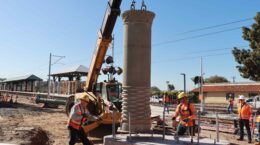
This week crews installed ten 88-foot long, 100,000 pound steel reinforced concrete girders on top of the Colorado Blvd bridge in Arcadia. Crews are now working to rebuild the street, curbs and gutters under the bridge, in anticipation of the street re-opening to traffic on Monday, May 20.

Share
May 17th, 2013
click here to comment


SGV Tribune Opinion: Metro must keep faith on the Gold Line

Posted by GoldLine

The following Opinion originally appeared in the Friday, May 10, 2013 print edition of the San Gabriel Valley Tribune and Pasadena Star-News.

Metro must keep faith on the Gold Line: Opinion

By Doug Tessitor and Sam Pedroza

In November 2008, a supermajority of Los Angeles County voters supported Measure R, Metro’s half-cent sales tax increase for transportation. An estimated $40 billion in tax revenue is being generated over thirty years for transit, highway and other projects to improve mobility.

One of the transit projects specified in Measure R is the Gold Line Foothill Extension to Claremont.

Measure R is providing enough funding to build the first half of the light rail line from Pasadena to Azusa. In order to complete the full project to Claremont, an additional $950 million is needed.

The Foothill Extension is no different in this regard than other Measure R projects – additional funds must be found in order to complete the program and meet the voter mandate.

According to Metro documents, billions of dollars must be located from other sources over the coming years to complete the Measure R transit program alone.

Metro has been working on numerous strategies to fill that funding gap.

They have asked voters to extend the county tax, requested grants and loans from the federal government, and worked to partner with the private sector.

To date, these strategies have included plans to complete the Purple Line, the Green Line, and other Measure R transit projects – with one exception: the Foothill Extension.

The Foothill Extension is the only project where Metro has decided to shorten the project to fit the funding, rather than commit to finding the funding to complete the project. A double standard position that the LA city-centric agency is comfortable taking.

The unfortunate message is clear – Metro is committed to completing all Measure R projects, with the exception of the Foothill Extension to Claremont; and without Metro’s commitment to completing the project, funding the line to Claremont will be all but impossible.

The Foothill Extension is a true success story for Measure R and the voters of Los Angeles County.

The Pasadena to Azusa segment was the first Measure R rail project to break ground, and it is on budget and on time.

It will be completed in 2015, when the Construction Authority building the line will turn it over to Metro.

The Azusa to Claremont segment, now environmentally cleared, is being readied for design and engineering in anticipation of a groundbreaking in as early as 2016.

It is time for Metro to stop making excuses for not completing the Foothill Extension and do the right thing.

The voters approved a program of projects carefully crafted by the California State Legislature, which including the Foothill Extension to Claremont.

It was one of only two transit projects with such a clear definition.

It is time for Metro to keep faith with the voters and commit to completing all Measure R projects as promised, including the Foothill Extension – all the way to Claremont.

Doug Tessitor is a Glendora city councilman who serves as chairman of the Metro Gold Line Foothill Extension Construction Authority’s Board of Directors and on the Executive Board of Foothill Transit. Sam Pedroza is a Claremont city councilman who serves on the Construction Authority’s Board of Directors and as chairman of the Foothill Extension Joint Powers Authority Board. The Construction Authority is an independent transportation agency responsible for planning, designing and building the Gold Line Foothill Extension.

Share
May 10th, 2013
click here to comment


Construction Update and Picture of the Week

Posted by GoldLine

Crews grade the area at the future Arcadia station in anticipation of beginning work on the platform foundations.

Share
May 10th, 2013
click here to comment


Construction Update and Picture of the Week

Posted by GoldLine

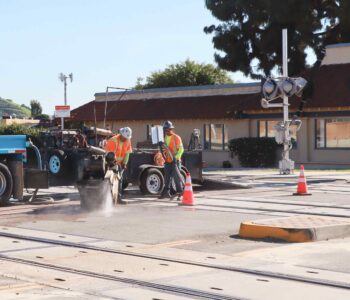
Palm Drive in Azusa re-opened to pedestrian and vehicular traffic this week after being closed four months for construction of supports for three rail bridges.

Share
May 3rd, 2013
click here to comment


Metro Board approves station names for Foothill Extension from Pasadena to Azusa

Posted by GoldLine

Metro Gold Line Foothill Extension Logo

At their meeting on Thursday of this week, the Metro board approved the following names for the future Foothill Extension stations:

    - Arcadia
    - Monrovia
    - Duarte/City of Hope
    - Irwindale
    - Azusa Downtown
    - APU/Citrus College

    Here is what just some people are saying to “The Source” in response to the name approval:

    “L A McRae on April 25, 2013 at 1:06 PM said: I’m SO excited about the Gold line extension to Arcadia! The station is within 5 mins walking distance from my home & there are stations within 5 mins walking distance of both of my jobs! My poor 10 year old car will get to rest at least a few days a week!”

    El Peatón on April 25, 2013 at 3:39 PM said: “No Azusa Downtown/Ridley-Thomas or Duarte/City of Hope/Tom Bradley station? I’m very surprised. Thank you Metro for keeping things simple.”

    Just a person on April 25, 2013 at 1:39 PM said: “Some nice simple and logic names!!!!!!!”

    Let us know what you think? Send us a comment.

    Share
    April 26th, 2013
    click here to comment


    Construction Update and Picture of the Week

    Posted by GoldLine

    Construction of the 24-acre Gold Line Operations Campus is moving along rapidly. As shown in this aerial photo, underground utilities are being installed throughout the campus and foundation work completed on the on-site buildings.

    REMINDER: A three-month closure of Azusa Avenue at the railroad crossing in Azusa begins next Monday, April 29, 2013. Click here for details.

    Share
    April 25th, 2013
    click here to comment


    Construction Authority Board Meeting

    Posted by GoldLine

    http://www.foothillextension.org/images/logo-metro-gold-line.jpg

    The Construction Authority Board of Directors will be holding a meeting on Wednesday, April 24, 2013 at at 7:00 p.m. The meeting is open to the public and will be held at the Metro Gold Line Offices, 406 E. Huntington Drive, Suite 202, Monrovia, CA 91016 . Click here for more information or to view the meeting agenda and reports.

    Share
    April 23rd, 2013
    click here to comment


    Sign Up for Updates


    ©Copyright 2009-11 I Will Ride.org. All rights reserved.
    unlock at&t iphone 4 question . unlock apple iphone 4 . unlock at&t iphone 4 imei